
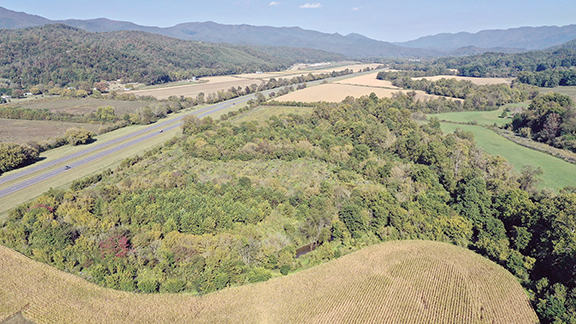
A total of 26,000 acres of Cherokee County farmland seems like a large number. But a zoom out reveals Cherokee County has almost 300,000 acres in total. This means that among the 277 farms in the county, each one averages about 95 acres. And those numbers are shrinking.
It’s this shrinkage that motivates Evan Davis, director of the state’s Farmland Preservation Division. His department falls under the supervision of the N.C. Department of Agriculture & Consumer Services, which exists to preserve, grow and develop working farms and forests. The organization is funded through a trust.
“The N.C. Agricultural Development & Farmland Preservation Trust Fund supports North Carolina’s agricultural economy by providing grants to county governments and nonprofit organizations for conservation easements, agricultural development projects and agricultural plans,” he said.
These grants are necessary. In June 2020, The American Farmland Trust published their study on farmland loss in America.
“The study found that North Carolina is the second-most threatened state for farmland loss in the United States,” Davis added, with Texas at the top.
“Based on their analysis, 732,000 acres of [N.C.] agricultural land were converted from 2001 to 2016,” he said.
Davis has some ideas on how to slow farm loss in Cherokee County.
“The Farmland Preservation Division is proposing the creation of Agricultural Growth Zones,” he said.
These zones are a two-pronged initiative specifically designed to slow farmland loss and build working land communities.
“These large blocks of permanently protected land can act as a sprawl management tool and are most effective when they are coordinated with other planning efforts such as the Voluntary Agricultural Districts program and urban growth boundaries,” Davis said.
There are agricultural conservation easements in 52 of the 100 counties in North Carolina, he added. Cherokee County has five such easements, with Mainspring Conservation Trust holding two open grant contracts for perpetual agriculture conservation easements.
Davis discussed why farm loss in North Carolina is alarming. The AFT’s study graded land characteristics, including prime soils to create “nationally significant land,” Davis said.
“They conclude that it takes two to three times the amount of marginal agricultural land to make up for the productivity of Nationally Significant Land,” he added.
More than half of the agricultural land in North Carolina – 59 percent – is graded nationally significant.
“The AFT determined North Carolina lost 387,500 acres of our best and most productive land between 2001 and 2016,” Davis said.
This loss has serious budgetary repercussions. Agriculture is North Carolina’s top industry, amounting to almost 16 percent.
In dollars that’s about $90 billion, of the $589 billion gross state product. And these farms produce more than the big three, vegetable, dairy and meat.
“Working lands provide fresh, local foods to North Carolina residents and quality products to the agriculture, forestry, and fiber industries,” Davis said.
Their bucolic beauty is commoditized in tourists’ dollars and farmland contributes to erosion control and carbon management.
So if the Cherokee County farmlands that are so vital to a robust lifestyle and economy continue to diminish, what will be the outcome? The AFT rebooted their 2020 study when they released “Farms Under Threat 2040: Choosing an Abundant Future” in June. Davis offered a summation of their projected outcomes.
“There are three future scenarios modeled in the report. Business as usual (follows recent development trends), Runaway sprawl (higher development in suburban and rural areas), Better built cities (compact and dense development),” the study says.
However, the new report offers more bad news for North Carolina, which again ranked second in the nation for projected agricultural land lost in all three projected scenarios. Davis broke the numbers down for Cherokee County.
“Business as usual: 4,500 acres; Runaway sprawl: 9,000 acres; Better built cities: 3,100 acres.”
The remedy, he argued, is to preserve the existing farms through the Mainspring Conservation Trust.
If any local or regional landowners are interested in preserving their family farm or forest, contact the Farmland Preservation Division at 919-707-3701 or www.ncadfp.org.